Happy Birthday, Robert Burns!

Here’s to Robert Burns and all the Scots and poetry lovers out there who are celebrating his birthday today! Enjoy your Haggis and Happy Birthday, Robert!

Address To A Haggis

Fair fa’ your honest, sonsie face,
Fair and honest your happy face
Great chieftain o’ the puddin-race!
You Chief of the pudding-race!
Aboon them a’ ye tak your place,
Above them all you take your place,
Painch, tripe, or thairm:
Stomach, tripe, or guts:
Weel are ye wordy of a grace
Well are you worthy of a grace
As lang’s my arm.
As long as my arm.

The groaning trencher there ye fill,
The groaning platter there you fill,
Your hurdies like a distant hill,
Your rump like a distant hill,
Your pin wad help to mend a mill
Your skewer would help to mend a mill
In time o’ need,
In time of need,
While thro’ your pores the dews distil
While through your pores the juices seep
Like amber bead.
Like amber beads.

His knife see rustic Labour dight,
His knife see the serving man clean
An’ cut ye up wi’ ready slight,
And cut you up with great skill
Trenching your gushing entrails bright
Making a trench in your bright, gushing guts
Like onie ditch;
Like a ditch;
And then, O what a glorious sight,
And then, what a wonderful sight,
Warm-reekin, rich!
Warm-steaming, rich!

Then, horn for horn, they strech an’ strive:
Then spoonful after spoonful they stretch and strive:
Deil tak the hindmost! on they drive,
The devil will get the last bit! On they drive,
Till a’ their weel-swall’d kytes belyve,
Until all their well-stretched stomachs, by and by
Are bent like drums;
Then auld Guidman, maist like to rive,
Then head of the family, about to burst,
‘Bethankit!’ hums.
Murmurs, “Thank the Lord!”

Is there that owre his French ragout
Is there that over his French ragout
Or olio that wad staw a sow,
Or Italian food that would sicken a sow (pig)
Or fricassee wad mak her spew
Or fricassee that would make her spew
Wi’ perfect sconner,
With perfect disgust,
Looks down wi’ sneering, scornfu’ view
Would look down with sneering, scornful view
On sic a dinner?
On this dinner? (Haggis)

Poor devil! see him owre his trash,
Poor devil! See him over his trash,
As feckless as a wither’d rash,
As feeble as a withered bullrush,
His spindle shank, a guid whip-lash,
His skinny leg no thicker than a thin rope,
His nieve a nit;
His fist a nut;
Thro’ bluidy flood or field to dash,
Through bloody river or field to run,
O how unfit!
How unfit he’d be.

But mark the Rustic, haggis-fed,
But look at the healthy, Haggis-fed person,
The trembling earth resounds his tread.
The earth trembles under his foot.
Clap in his walie nieve a blade,
Put a knife in his fist,
He’ll make it whissle;
He’ll make it whistle (work);
An’ legs, an’ arms, an’ heads will sned,
And legs, and arms, and heads will shed (come off)
Like taps o’ thrissle.
Like tops of thistles.

Ye Pow’rs wha mak mankind your care,
You powers who care about mankind,
And dish them out their bill o ‘fare,
And give them their food,
Auld Scotland wants nae skinking ware
Scotland does not want watery, wimpy stuff
That jaups in luggies;
That splashes in wood bowls;
But, if ye wish her gratefu’ prayer,
But, if you want her gratitude,
Gie her a Haggis!
Give her a Haggis!

What is Haggis? It used to be the liver, lungs and heart of a sheep, boiled, minced and mixed with onions, oatmeal, salt, pepper and spices then stuffed in a sheep’s stomach and boiled again.

Nowadays, it is prepared with the best meats, oatmeal, and spices and stuffed like a sausage and boiled.

I’ve never had it, but maybe today’s the day. A toast to Robert Burns.

Emily Dickinson Knew Winter

Everything, depending on our circumstance, takes on different meaning. Winter, to a person well-fed, sitting by a fire with loved ones in good health, means only beauty and wonder; for them it is a time to rest, reflect, celebrate and enjoy. Yet, a person who has lost someone they loved, and has been shaken by the tenuousness of life, might look at that same winter scene as something harsh, ominous, and unmerciful.

The way I see winter and the way Emily sees it in the poem below are so different, and yet, I know that part of this human experience is to go through all the seasons, each in their time. As Emily experienced whatever loss of hope she did here, we will have our season of experiencing the same thing: an oppressive heft, heavenly hurt, scars you feel, but can’t see. See how internal difference almost forms the word indifference where she looks for Meaning with a capital “M”? She warns that nothing can prepare us for this type of hurt and we won’t be able to find meaning in it.

There’s a certain Slant of light,
Winter Afternoons —
That oppresses, like the Heft
Of Cathedral Tunes —

Heavenly Hurt, it gives us —
We can find no scar,
But internal difference,
Where the Meanings, are —

None may teach it — Any —
’Tis the Seal Despair —
An imperial affliction
Sent us of the Air —

When it comes, the Landscape listens —
Shadows — hold their breath —
When it goes, ’tis like the Distance
On the look of Death —

I’ve never experienced anything quite like this, close, but not the same. I know people who have: two friends, one who lost a son to suicide and the other a husband. I imagine they would know exactly what Emily is writing about in these lines.

I feel lucky today that I can look out on the winter landscape and largely miss the shadows. To me, it’s still magical and full of wonder. Even the fog, it seems like the wrapping around a present that the sun will tear off to reveal more amazing things. How blessed am I? Today. How blessed are all of us who are enjoying winter. Today.

Robert Burns Knew Winter

As we get ready for the Winter Warlock to blow in (they say) 12″-24″ of snow to Spokane in the coming days, I have retreated to my conservatory. I can now sit in relative warmth and look out at the barn and horses, leafless trees, icey walk and…sun. Yes, sun. In fact, it’s very deceiving. You might think it’s actually warm out there and doubt the weatherman, but I know better. Before I sat down here to read and write, I had to walk out in it–bundled up, of course, to feed the horses and goats. When poets say the air bites, I know what they mean. Just that little bit of wind you stir by walking feels like thin ice whips across exposed skin. Ouch! To the Conservatory! God bless electricity and windows!

I don’t feature many male poets on my blog, but I’ve already established that I’m in love with Robert Burns so I turned to his lyrics to describe this late January cold. (His birthday is coming up in 9 days–January 25th–a holiday in Scotland.)

Winter: A Dirge by Robert Burns

The wintry west extends his blast,
And hail and rain does blaw;
Or the stormy north sends driving forth
The blinding sleet and snaw:
While, tumbling brown, the burn comes down,
And roars frae bank to brae;
And bird and beast in covert rest,
And pass the heartless day.

“The sweeping blast, the sky o’ercast,”
The joyless winter day
Let others fear, to me more dear
Than all the pride of May:
The tempest’s howl, it soothes my soul,
My griefs it seems to join;
The leafless trees my fancy please,
Their fate resembles mine!

Thou Power Supreme, whose mighty scheme
These woes of mine fulfil,
Here firm I rest; they must be best,
Because they are Thy will!
Then all I want—O do Thou grant
This one request of mine!—
Since to enjoy Thou dost deny,
Assist me to resign.

Two Female Composers from the Victorian Era

Today I want to celebrate two female composers of the 1800′s, both of whom were related (sister and wife, respectively) to famous male composers: Fanny Mendelssohn (1805-1847) and Clara Schumann (1819-1896).

Fanny Mendelssohn was said to be equally talented as her brother, Felix, but her father did not want her to have a career. “Music will perhaps become his [i.e. Felix's] profession, while for you it can and must be only an ornament”. Later, when she married, her husband had a different attitude and her own compositions were released first, under her brother’s name, and then later, under her own.

Listen to her composition, Trio op. 11. 4 Finale (above link) and tell me if she does not stand up against all the greats of that time, including her brother.

Unfortunately, neither Felix or Fanny lived long lives, both suffering strokes and leaving this world much too soon.

Clara Schumann lived a much longer, though maybe more tragic, life. Her husband, Robert Schumann, tried to commit suicide and ended the last two years of his life in an asylum, and four of her eight children died before she did and one also spent his life in an asylum. Yet, through it all, she was able to perform and compose and take her place as the main bread winner of the family.

She and Johannes Brahms (thirteen years her junior) had a very close relationship, though no one knows exactly how close. He was friend to both she and her husband and stood by her side during Robert Schumann’s hospitalization, helping her with their kids and somewhat taking on the role of the patriarch. They both had their personal letters between themselves destroyed after their deaths. Brahms D-Minor Piano Concerto represents his feelings about Schumann’s attempted suicide and his feelings for Clara.

She was a celebrated performing pianist in her lifetime and contributed largely to piano teaching techniques.

My favorite of her works–3 Romances for Violin & Piano Op. 22, wasn’t available to embed in this blogpost, so I added her Pianoconcerto in A minor, Op. 7, also beautiful. But if you go to youtube, you won’t be disappointed if you look for and listen to 3 Romances for Violin and Piano…and all her other pieces.

An Autumn Poem from Emily

Autumn

The morns are meeker than they were,
The nuts are getting brown;
The berry’s cheek is plumper,
The rose is out of town.

The maple wears a gayer scarf,
The field a scarlet gown.
Lest I should be old-fashioned,
I’ll put a trinket on.

~Emily Dickinson

Happy Thanksgiving!

Sunroom Addition

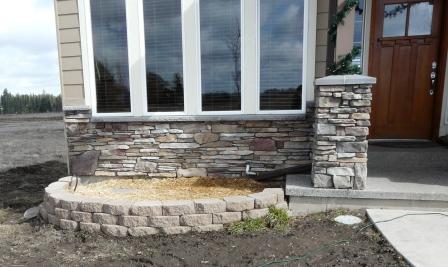
When my husband and I purchased our home almost five years ago, we bought a house in a field–no grass, trees, fences, gates, barns…nothing. The basement was just a concrete slab. Since then we’ve done all those things with the help of our kids.

When we toured the house, before buying it, we walked out on a very small deck and looked at each other and said–this will be one of the first things we change. Four and half years later, we finally got started.

Living through the cold Spokane winters, springs and falls, changed our dream even further. We started to imagine what life would be like with a sunroom–a place we could go during windy, rainy, snowy days and still experience our flowers and the outside. But it seemed like a very far off dream.

Luckily for us, that turned out not to be the case. My husband started to think it through and talk to others, and he realized he could do it himself…with the help of our sons–mostly his youngest, and to a smaller extent because of his other commitments, my youngest son…and YouTube.

Here are photos of the progression.

There’s still much more finish work to be done, but we’re almost there.

Update on the Sunroom Project

The conservatory project, sun room addition, is moving a long quickly and just in time for the bad weather that has moved in. Spokane is cold from October to June, what better place to have an indoor/outdoor room for my flowers.

The rest of our windows should arrive today via UPS. There are 9 of them. I’ve also ordered 4 antique windows from a 1904 home in Lower Michigan that will go across the front. I found them on eBay–my favorite site for all things hard to find.

I’m looking now for a used wood stove that has a glass front so I can heat the room during the winter with a real wood fire. Since this is an indoor/outdoor room, it will be very easy to bring one in and cut a hole for the vent before we add the siding.

I’ve been very surprised at how easy an addition like this is to do yourself. We also extended our deck which made it more expensive and time-consuming, but if we’d only done the sunroom, it would have been finished long ago. The requirements for a “porch” type addition like this are minimal. You do need to pour a foundation around it if you want to protect glass windows from being broken as the ground contracts with cold and heat, but that was relatively simple and fast. And, almost everything you need to know you can find on Youtube.

I highly recommend an addition like this for anyone who lives in a cold climate and wants to enjoy their garden year-round. The sky is the limit on how you can design it.

Wild Geese

Late summer and fall remind me of one of my favorite things–the migration of the wild geese. Years ago, when I was going through one of the hardest transitions of my life, I was out raking leaves in the backyard and flock after flock of the wild geese passed over me honking. How many times had they done that? A thousand? A million? And I didn’t really take notice. But that day they were able to lift me with them. I stopped raking and stood there for a long time, smiling, and every since that day I’ll run out of the house if I see them coming or I’ll stop whatever I’m doing, if I happen to be outside. They never cease to bring me a sense of…hope.

Mary Oliver is on my short list of poets who remind me most of Emily Dickinson. She may be the closest, in spirit, to her. She was influenced by another of my favorite poets who I’ve loved for many years, Edna St. Vincent Millay. (My favorite of her poems is Wine From These Grapes.) Here is a poem for this season by Mary Oliver, Wild Geese.

You do not have to be good.
You do not have to walk on your knees
For a hundred miles through the desert, repenting.
You only have to let the soft animal of your body
love what it loves.
Tell me about your despair, yours, and I will tell you mine.
Meanwhile the world goes on.
Meanwhile the sun and the clear pebbles of the rain
are moving across the landscapes,
over the prairies and the deep trees,
the mountains and the rivers.
Meanwhile the wild geese, high in the clean blue air,
are heading home again.
Whoever you are, no matter how lonely,
the world offers itself to your imagination,
calls to you like the wild geese, harsh and exciting –
over and over announcing your place
in the family of things.

Building a Conservatory

Emily Dickinson’s Conservatory

One way I feel connected to Emily is the similar climates in which we nurture our gardens. There’s a great deal of the year that is cold. Like her, I’ve wanted a Conservatory.

This year my husband and I decided to get started on it.

We had the plans drawn up–$400.00, the permit purchased–$500.00 and the concrete footing poured–$500.00. Now we are in the process of getting bids on the materials–wood, windows, french doors.

It will largely be an outside room–a covered porch of sorts–but we’ll try to keep it always above freezing. In the spring and summer we’ll open the windows and doors and let the breeze blow through. In the late fall and winter we’ll close it up and allow only the light in.

Here is what’s growing in my garden in August.

Day Lily

Echinacea

Gay Feather

Oregano

Quaking Aspen

Riding Through a Grove of Aspens

The sweeping of our horses’ manes
Showed us the wind and which way it blew,
But it was the aspens that gave it voice.

Swirling leaves,
Like erratic wings of butterflies,
shimmered, shook, slapped,
Simultaneously clapping as we passed.

Grace in the grove, the ticking,
whispering clatter of the breeze
Passing back and forth between worlds,
Spirit and sound merged together.

There,
We didn’t question deserving,
Or consecration,
Or forgiveness.
Rather, we listened,
wide-open and happy.

And finally, as if beckoned,
The cry of crow and its echoes,
Defiant, yes, and provocative
The rasping call to the universe
The caw-caw of survival,
As we rode, quiet, through.

Linda Reznicek, June 23 2011

From the site of The East Multnomah Soil and Water Conservation District (EMSWCD)

Do not plant near underground sewer or water pipes.

Populus tremuloides, the Quaking Aspen or Trembling Aspen, is a deciduous tree native to cooler areas of North America, with the northern limit determined by its intolerance of permafrost. In the United States, it occurs at low elevations as far south as northern Nebraska and central Indiana. In the western United States, this tree rarely survives at elevations lower than 1,500 feet due to the mild winters experienced below that elevation, and is generally found at 5,000-12,000 feet.

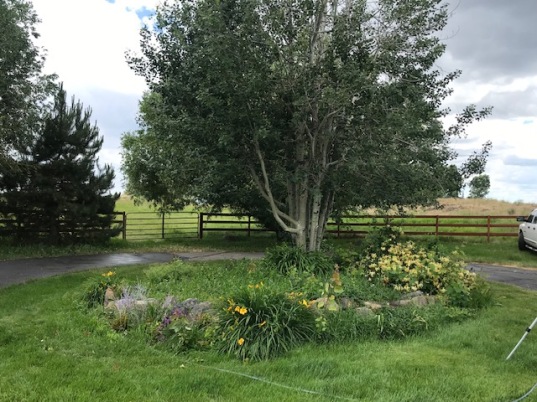
(Emily Dickinson’s Garden says, Spokane’s elevation is a little over 1,800 feet and higher here North/West of Spokane. In fact, our garden is at 2370 feet and the aspen are thriving. It has also been a very cold group of winters/springs for the last four years since we planted. Aspens seem to thrive in cold, windy conditions.)

The name references the quaking or trembling of the leaves that occurs in even a slight breeze due to the flattened petioles. Other species of Populus have petioles flattened partially along their length, while the Quaking Aspen’s are flattened from side to side along the entire length of the petiole. This quaking of the leaves produces a soft sound that many consider a hallmark of the Quaking Aspen.

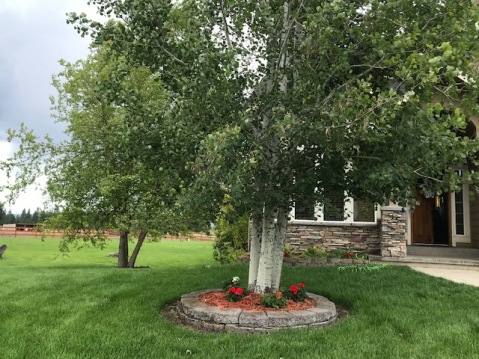
(EDG says, we have planted three. One has three trunks and the other are singles. We do love to listen to the sound of them clattering in the wind.)

It is a tall tree, usually 20 to 25 meters (66 to 82 feet) at maturity, with a trunk 20-80 cm diameter; records are 36.5 m height and 1.37 m diameter. The leaves on mature trees are nearly round, 4-8 cm diameter with small rounded teeth, and a 3-7 cm long, flattened petiole. Young trees (including root sprouts) have much larger (10-20 cm long), nearly triangular leaves.

It propagates itself by both seed and root sprouts, and extensive clonal colonies are common. Each colony is its own clone, and all trees in the clone have identical characteristics and share a root structure. A clone may turn color earlier or later in the fall than its neighbouring aspen clones. Fall colors are usually bright tones of yellow; in some areas, red blushes may be occasionally seen. As all trees in a given clonal colony are considered part of the same organism, one clonal colony, named Pando, is considered the heaviest and oldest living organism at six million kilograms and approximately 80,000 years old.

(EDG says, that is AWESOME. Would love to see an 80,000 years old organism, wouldn’t you? Thanks for the information, please follow the link above if you’d like to read more.)